
30.4% of the vehicles that take engine oil in 13 Peninsula ZIP codes are model year 2011 or earlier: 84,200 of 276,915 light-duty cars, trucks and SUVs registered as of December 31, 2025, according to California DMV registration counts. That is close to the statewide figure of 31.7%, and in Redwood City's 94063 it reaches 41.3%.
This is our plain-language read of the state's own registration numbers, plus what an engine that old actually needs at an oil change, including when high mileage oil is worth it, from a family-owned drive-thru that has changed oil on El Camino Real since 1976. Every number below comes from the DMV file, and the method section shows exactly how we counted.
When we say older cars, we mean both the high-mileage commuter that has crossed 150,000 miles and the low-mileage second car that mostly sits in the garage, because both are model year 2011 or earlier and both have aging seals. If you have kept the same car since it was new, you're probably wondering whether it needs something different now. If you just bought an older car to get around town, you want to know what to watch. And if a newer car or an EV sits next to an older one in your driveway, the older one is the car most likely to need your attention.
By the end you'll know how your ZIP code compares, whether high mileage oil makes sense for your engine, and a two-minute dipstick check that catches leaks and oil use early. We cover it in four parts: the numbers by ZIP, why the Peninsula's oil-burning cars are getting older, what older engines need, and exactly how we counted.
Cars 2011 or Older, by Peninsula ZIP Code
Across the 13 ZIP codes, the share of oil-burning vehicles from model year 2011 or earlier runs from 22.9% in Atherton (94027) to 41.3% in Redwood City's 94063. San Carlos (94070) sits at 26.3%, which is 5,879 of 22,349 vehicles. Redwood City's four ZIPs together come to 34.5% and San Mateo's three come to 33.7%. Both cities are a short drive up or down El Camino from us, and we keep the routes and prices for an oil change near Redwood City and for San Mateo drivers on their own pages.
Share of vehicles that take engine oil that are model year 2011 or earlier, by ZIP code
Light-duty vehicles registered in 13 Peninsula ZIP codes as of Dec 31, 2025. San Carlos (94070) All 13 ZIPs 30.4% California 31.7%
ZIPs with more electric cars have fewer old ones. The three lowest ZIPs, Atherton, Redwood Shores (94065) and Burlingame and Hillsborough, all have battery electric shares above 14% of light-duty registrations, against 5.1% in 94063. Even in Atherton, more than one in five cars that take oil is 2011 or older.
| ZIP and place | Take oil | 2011 or earlier | Share |
|---|---|---|---|
| 94063 Redwood City | 27,107 | 11,202 | 41.3% |
| 94401 San Mateo | 24,127 | 9,573 | 39.7% |
| 94061 Redwood City | 25,143 | 8,711 | 34.6% |
| 94403 San Mateo | 29,379 | 9,093 | 31.0% |
| 94402 San Mateo | 18,915 | 5,739 | 30.3% |
| 94062 Redwood City | 19,088 | 5,570 | 29.2% |
| 94002 Belmont | 18,856 | 5,324 | 28.2% |
| 94025 Menlo Park | 26,122 | 7,042 | 27.0% |
| 94070 San Carlos | 22,349 | 5,879 | 26.3% |
| 94404 Foster City | 23,130 | 5,816 | 25.1% |
| 94010 Burlingame and Hillsborough | 30,126 | 7,364 | 24.4% |
| 94065 Redwood City | 7,786 | 1,793 | 23.0% |
| 94027 Atherton | 4,787 | 1,094 | 22.9% |
| All 13 ZIPs | 276,915 | 84,200 | 30.4% |
| California | 27,890,943 | 8,831,135 | 31.7% |
Download the per-ZIP table (CSV) with every model year band, battery electric counts and the source line. You're welcome to use it; please credit Perfect Lube Car Care and the California DMV.
Picture a 2008 minivan in 94063 that has done school runs since it was new. About 4 in 10 cars on its street that still take oil are just as old or older. Across these ZIPs, older cars are close to a third of everything that pulls in for an oil change, so the advice below applies to a lot of drivers.
Peninsula Cars That Take Oil Are Getting Older
The share of Peninsula oil-burning cars that are 15 or more model years old edged up from 29.5% in the January 2022 DMV file to 30.4% in the January 2026 file, while California held near 31.7%. Nearly half, 48.2%, are model year 2015 or earlier, so 10 or more model years old.
Share of vehicles that take engine oil that are 15 or more model years old, 2022 to 2026
13 Peninsula ZIPs California
The likely reason is electric cars. Battery electric vehicles make up 12.4% of light-duty registrations in these ZIPs, and 97.3% of them are model year 2016 or newer. Among model year 2023 vehicles registered here, 40.0% are battery electric. Every new car that goes electric drops out of the oil count, since a Tesla never needs an oil change, so the cars that still take oil skew older each year. Picture a household that buys an EV for the commute and keeps the 2010 SUV for weekends: the SUV is the one that still needs oil changes.
Hybrids run younger than gas-only cars: 16.3% of hybrids that take oil are 2011 or earlier, against 33.3% of gasoline cars, and almost no plug-in hybrids are that old (4 vehicles). Among the older cars where the DMV names a make, Toyota (14,501) and Honda (7,701) lead by a wide margin, but the DMV files 63.2% of these older vehicles under a combined "OTHER/UNK" make, so treat make rankings as rough. If yours is one of them, our oil change prices by brand show what Peninsula dealers charge for 14 makes.
When High Mileage Oil Makes Sense for an Older Engine
An older engine needs the grade and spec in its owner's manual, an oil change on the manual's schedule, and someone watching for leaks and oil use. High mileage oil is the same viscosity grade with extra seal conditioners and additives for worn engines. It helps when an engine seeps or uses oil and is optional when the engine is dry and steady.
A 2011 car can have 60,000 gentle miles or 250,000 hard ones, and most high mileage oils are marketed for engines past 75,000 miles. Go by how your engine behaves:
- If the engine is dry and the level holds between changes, keep the grade and spec your manual lists. A high mileage version of that grade won't hurt, but in our view the grade on the oil cap matters more than the words on the bottle.
- If it leaves small spots where you park or you add some oil between changes, try a high mileage oil in the same grade for a change or two, then watch the dipstick and the driveway. Seal conditioners can slow seeps from seals that have hardened with age, and the effect lasts only while you keep using the oil.
- If it leaves a puddle, smokes blue or you add more than about a quart between changes, a different oil only buys time. Have the leak or oil use diagnosed by a repair shop. If the red oil pressure light comes on while you drive, pull over and turn the engine off.
Whatever the label says, the bottle should show the API service symbol with the category your manual calls for. The American Petroleum Institute's Engine Oil Licensing and Certification System runs physical, chemical and performance tests on licensed oils and checks that the marks on the container are accurate, so the symbol is a better guide than the front label. Keep the viscosity your manual lists, too; switching to a thicker grade on your own is a common forum tip, and it is not one to try without the manual's say-so.
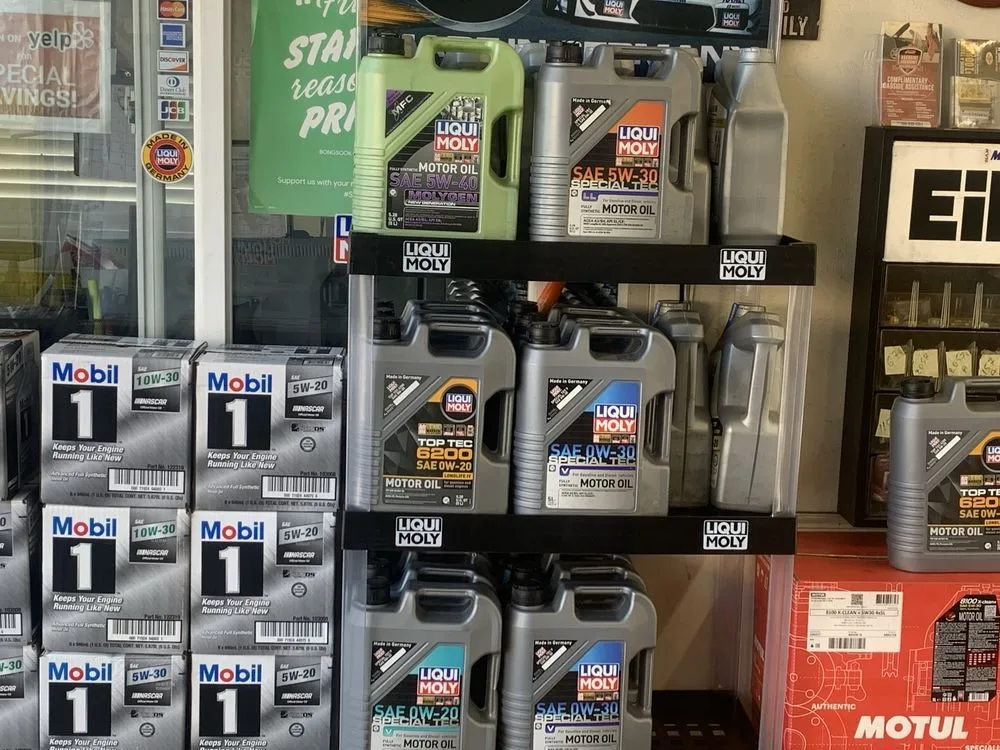
Say you drive a 2010 Civic with 140,000 miles. It leaves a coin-sized spot on the garage floor each week, and you add half a quart before every change. That is the textbook case for a high mileage oil in the grade the oil cap calls for: switch at the next change, note how much you add over the next few thousand miles, and see whether the spot shrinks. Now picture a 2011 RX 350 in Hillsborough with 90,000 careful miles, a clean floor and a level that never moves. Its owner can skip the upgrade and spend the difference on staying on schedule.
On an older engine, stick to the schedule in the manual instead of stretching it. Many manuals list a shorter interval for short trips and stop-and-go driving, which describes a lot of Peninsula errands; our guide to how often to change your oil walks through how to read yours. If your manual allows a synthetic blend, which is common on engines this age, our synthetic blend oil change is $89.99 with 5 quarts, a standard spin-on filter and the $5 environmental fee included. If you want a high mileage oil, tell us at the window and we'll tell you straight whether we have it in your grade.
Checking the Dipstick on an Older Car
Check the oil level on an older car once a month and before a long drive. It takes two minutes, needs nothing but a paper towel, and is the simplest way to catch a leak or rising oil use before it turns into engine damage.

- Park on level ground, turn the engine off and wait a few minutes (your manual gives the exact wait).
- Pull the dipstick, wipe it clean and push it all the way back in.
- Pull it again and read where the oil reaches between the low and full marks.
- Look at the oil on the towel: milky or foamy oil, or a gritty feel, means a mechanic should look at it soon.
- Write down the date, the mileage and anything you add, and bring the note to your next oil change.
On many cars the space between the two marks is about one quart, so a level at the low mark usually means you are about a quart short. Some newer BMW and Mercedes-Benz models have no dipstick at all and show the level in the dash menu instead. Picture a 2009 Tacoma owner who logs a quarter quart in May, half a quart in July and a full quart by September. That log shows the engine using more oil each month, and it gives whoever looks at the car next something concrete to go on.
How We Counted
We counted light-duty vehicles registered in 13 ZIP codes in the California DMV's Vehicle Fuel Type Count by Zip Code dataset, using the file labeled 1/1/2026, whose counts are dated December 31, 2025. "Takes engine oil", and "gas cars" in our headline, means every fuel type with a combustion engine: gasoline, diesel and diesel hybrid, flex-fuel, hybrid gasoline, plug-in hybrid and natural gas. Counting the DMV's "Gasoline" category alone, the share is 33.3%, so the headline holds either way.
- We left out battery electric (39,102) and hydrogen fuel cell (94) vehicles, which have no engine oil, and 12 vehicles the DMV lists under "Other" fuel without saying what they are. Heavy-duty and unknown-duty rows are excluded.
- 2011 or earlier is the DMV's own "<2012" model year group. The file does not break those years out, so we cannot say how many are, for example, older than 2000.
- Natural gas adds only 28 vehicles. Leaving it out gives 84,184 of 276,887, still 30.4%. Counting all light-duty vehicles, electric cars included, 26.6% are 2011 or earlier.
- The ZIPs are 94070 San Carlos, 94002 Belmont, 94061, 94062, 94063 and 94065 Redwood City, 94401, 94402 and 94403 San Mateo, 94404 Foster City, 94025 Menlo Park, 94027 Atherton and 94010 Burlingame and Hillsborough. ZIP boundaries do not match city limits exactly.
- The trend uses the 1/1/2022 to 1/1/2026 files with a moving cut (model year 15 or more years before the file year). Older files group model years too coarsely for the same cut. Some vehicles in every file have an unknown duty class; adding them back gives 30.1% in 2022 and 31.3% in 2026, so the direction holds, though that version dips in 2024.
- Registration is not road use. A registered car may be garaged most of the year, and a car is counted at the ZIP it is registered to, not where it is driven.
We pulled the full statewide files from data.ca.gov on October 10, 2026, totaled them with a script, and checked the headline a second way with separate code; both gave 84,200 of 276,915. The DMV posts a new file each year, and we'll update this page when the next one lands.
Frequently Asked Questions
Is high mileage oil worth it?
It is worth it when an older engine seeps oil or needs topping up between changes, because high mileage oils carry extra seal conditioners and additives aimed at worn seals. If your engine holds its level and leaves no spots, the grade and spec in your owner's manual matter more than the high mileage label. Either way, stay with the viscosity your manual lists.
At what mileage should I switch to high mileage oil?
Most high mileage oils are marketed for engines past 75,000 miles, but mileage alone is not the trigger. Switch when the engine starts using oil between changes or leaves small spots where you park. A well kept engine at 120,000 miles with a steady dipstick can stay on the oil it has always used.
Can I switch back to regular oil after using high mileage oil?
Yes. High mileage oil is the same viscosity grade as the regular version, so you can go back at the next oil change. If the high mileage oil had slowed a small leak, expect the leak to come back gradually once you stop using it.
Does high mileage oil stop oil leaks?
It can slow small seeps from seals that have hardened with age, but it does not fix a failed gasket, a loose drain plug or a cracked part. If the car leaves a puddle rather than a spot, or you add more than about a quart between oil changes, have the leak found and repaired.
Bring Your Older Car to Perfect Lube's Drive-Thru
Close to a third of the Peninsula's cars that take oil are 2011 or older. Keeping one running well mostly means the right grade, watching for leaks and checking the level. We have changed oil on El Camino Real for 50 years, with prices on the board and no appointment. When yours is due, see our oil change prices and services and pull into the drive-thru in San Carlos.

 Call (650) 394-5374